Platform

One subscriber record from lead to truck roll

ISP Triage CRM ties billing, RADIUS, gear, maps, tickets, and QoE together — software we built because we operate networks. Managed engineering is our primary business; the platform is optional when you want the same stack we use.

Why operators adopt it

Fewer tools. Faster changes. Less churn.

After engineering work, many clients consolidate here so billing, auth, and quality share one customer record.

Fewer tool switches

Customers, RADIUS, routers, maps, tickets, and billing share one system — not a patchwork of logins.

Less billing busywork

Automate invoicing, payments, and overdue status so your team focuses on exceptions, not data entry.

Fewer “slow internet” cancellations

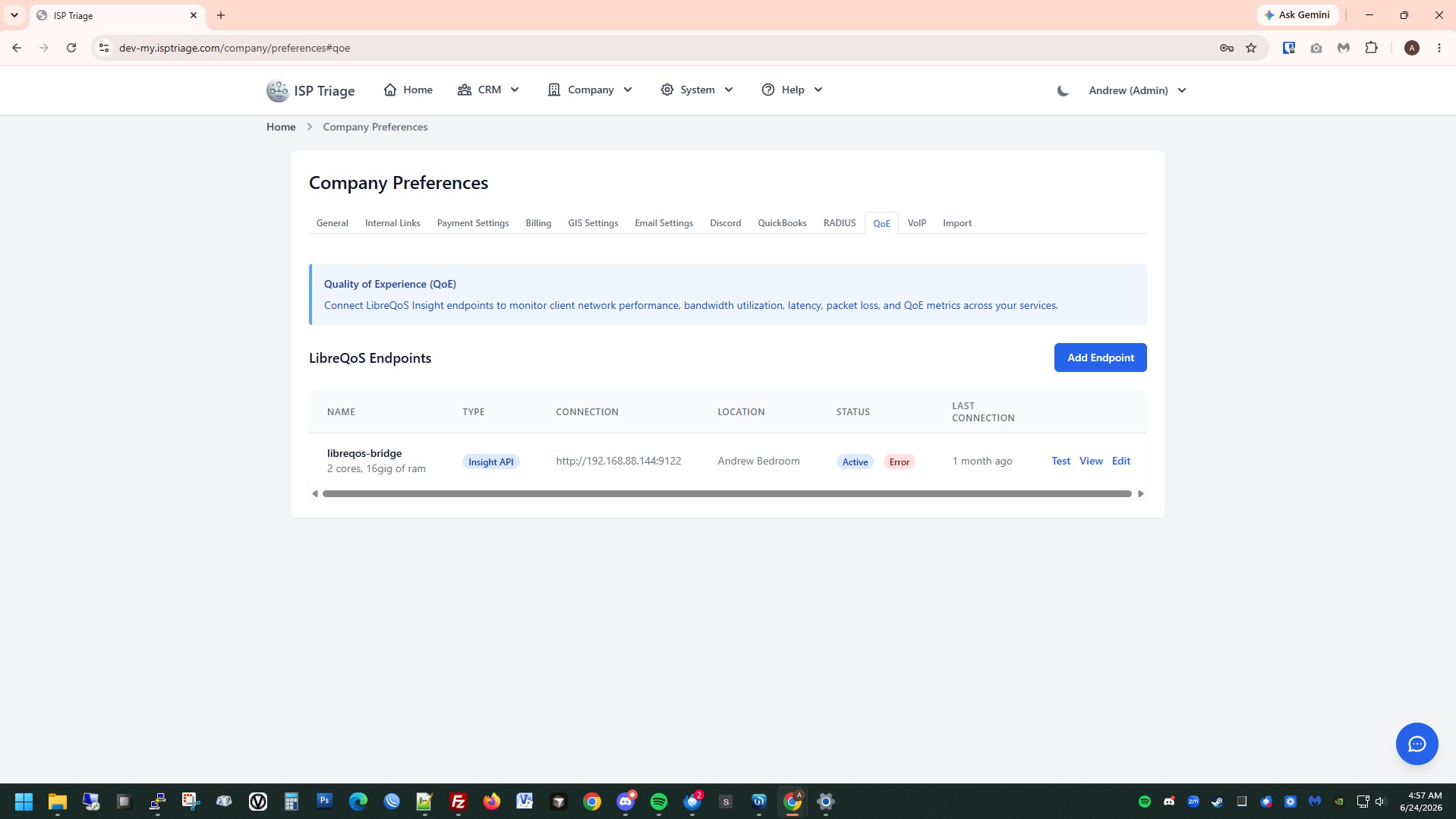
LibreQoS QoE scores turn quality drops into tickets before subscribers leave.

Built for real ISP gear

MikroTik-first, with UniFi and Cambium growing — not generic telecom software that ignores PPPoE and plant docs.

Capabilities

What the platform covers

Follow the subscriber lifecycle — from billing through auth, gear, plant, support, quality, voice, DNS, email, and the assistants you already use.

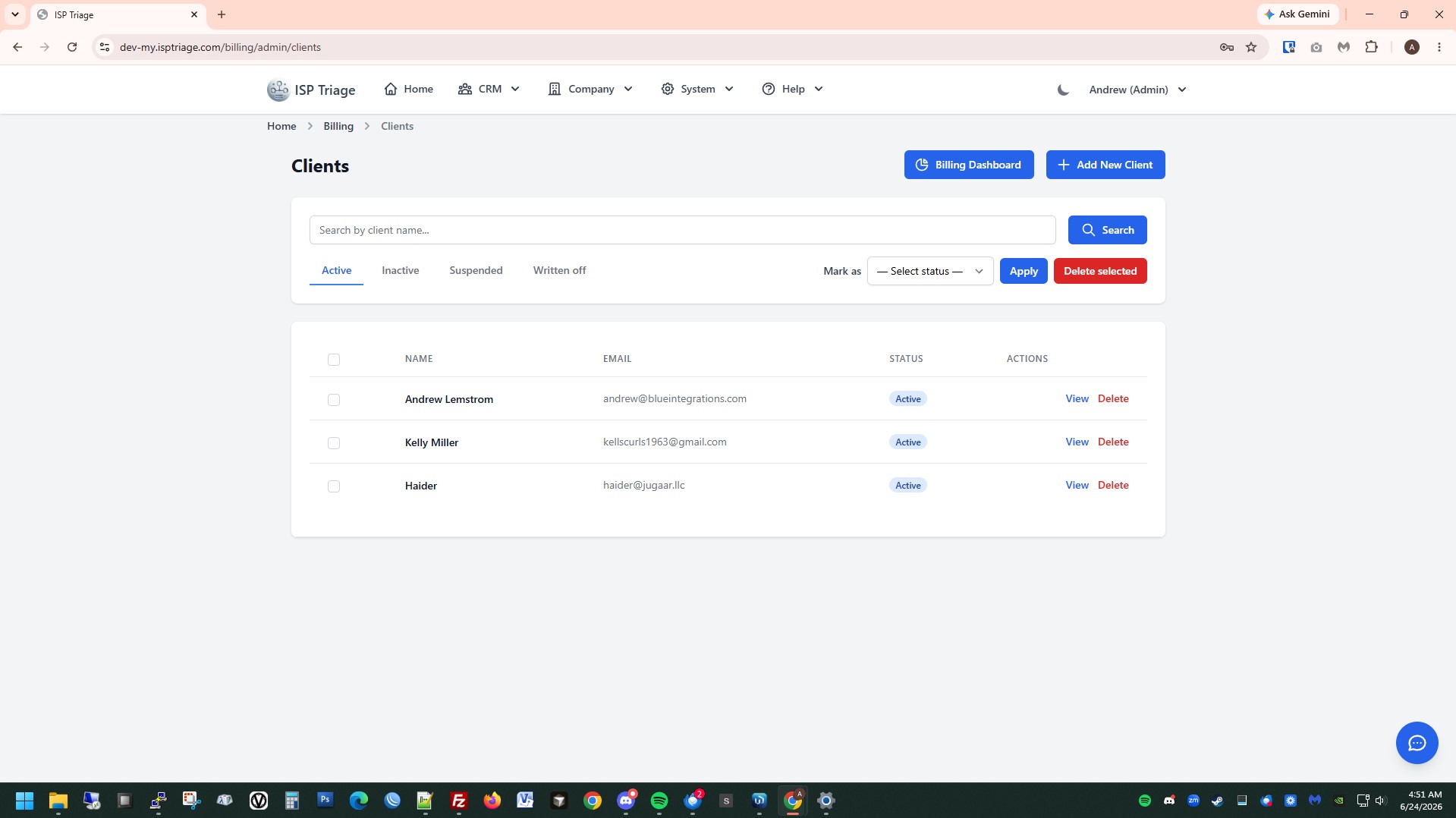
Customer & billing operations

The front office starts here — leads, services, and recurring revenue on the same record that later hits RADIUS and routers.

  • Multi-tenant: one installation, many ISP companies (with branded subdomains)
  • Client records, service templates, and automated recurring billing
  • Invoicing, tax handling (US/Canada), Stripe card payments, and customer self-service portal
  • Scheduled invoice generation, auto-pay, and overdue tracking

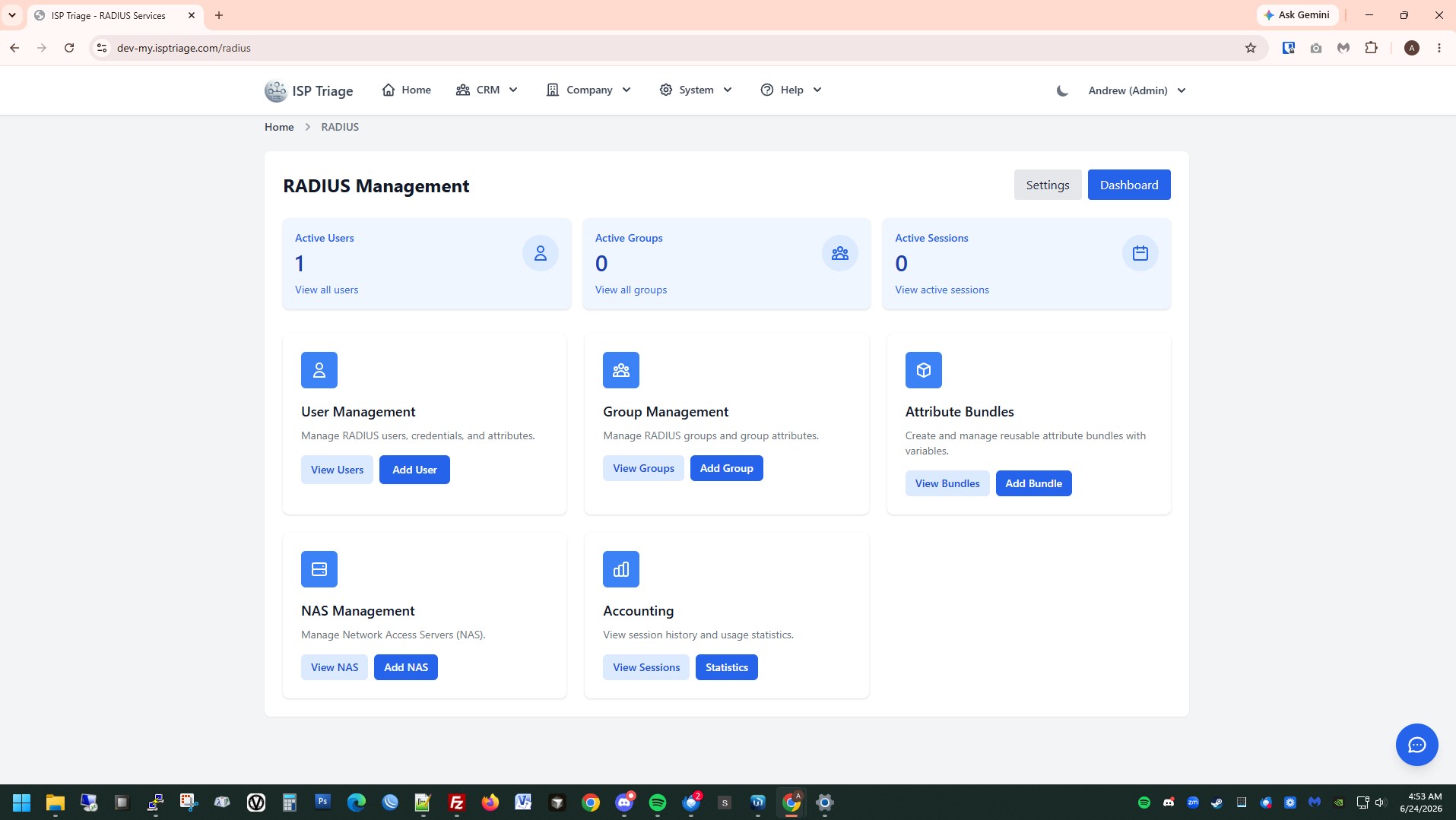
Network authentication (RADIUS)

When a service activates or suspends, FreeRADIUS and the customer record stay in sync — sessions, queues, and access follow the bill.

  • FreeRADIUS-backed users, groups, attribute bundles, and NAS management
  • Live session accounting, CoA/disconnect, MikroTik and Cambium vendor attributes
  • Tie subscriber changes to routers: PPPoE sync, queue updates, suspend/block by IP

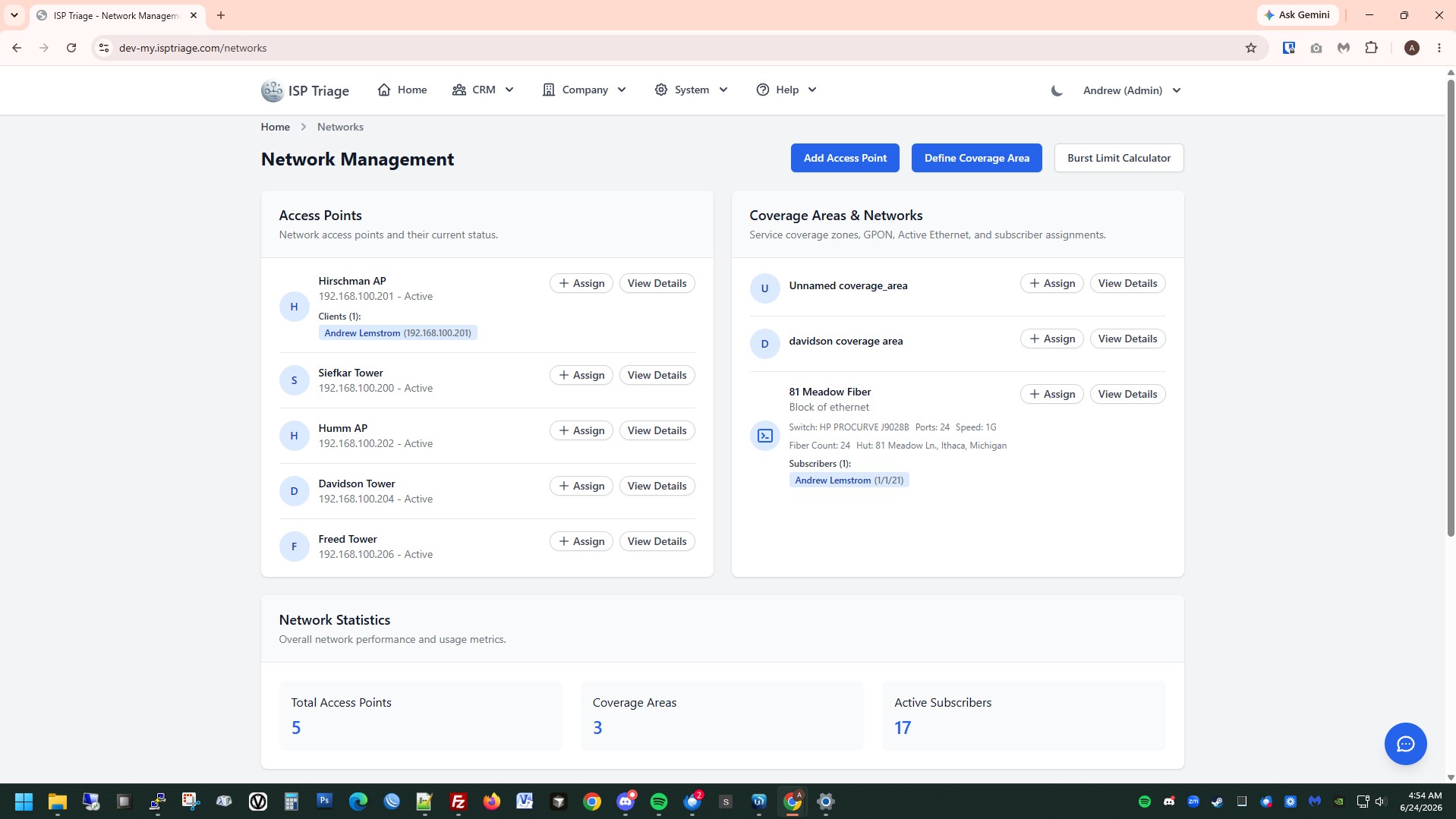
Multi-vendor network management

Control gear from the CRM instead of hopping box-to-box. Depth varies by vendor — we are transparent about what is production-ready today.

  • MikroTik (~80%) — interfaces, DHCP, queues, firewall, PPPoE, wireless clients, logs, RADIUS push
  • Ubiquiti UniFi (~30%) — devices, clients, SSIDs, VLANs, firmware, PoE, bandwidth limits
  • Cambium cnMaestro (~20%) — APs, subscriber modules, signal/throughput views
  • Credentials encrypted at rest; one dashboard instead of logging into every box

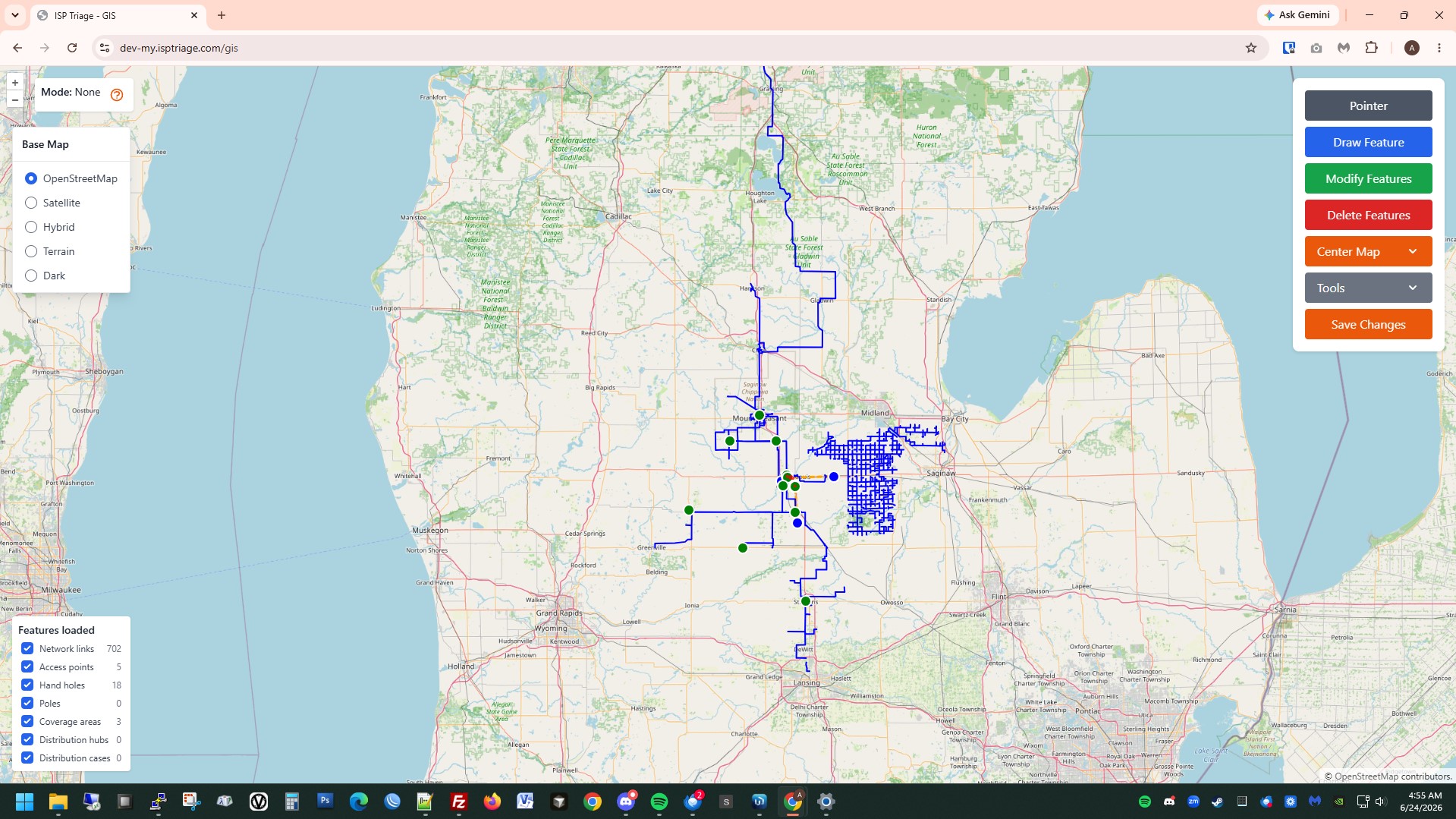
Maps & infrastructure (GIS)

Plant documentation lives next to the subscribers who sit on that fiber, wireless, or copper path.

  • Interactive maps for fiber, wireless, copper, access points, coverage, poles, and handholes
  • KML import/export for existing plant data
  • Embeddable maps for internal or customer-facing use

Support, projects & field work

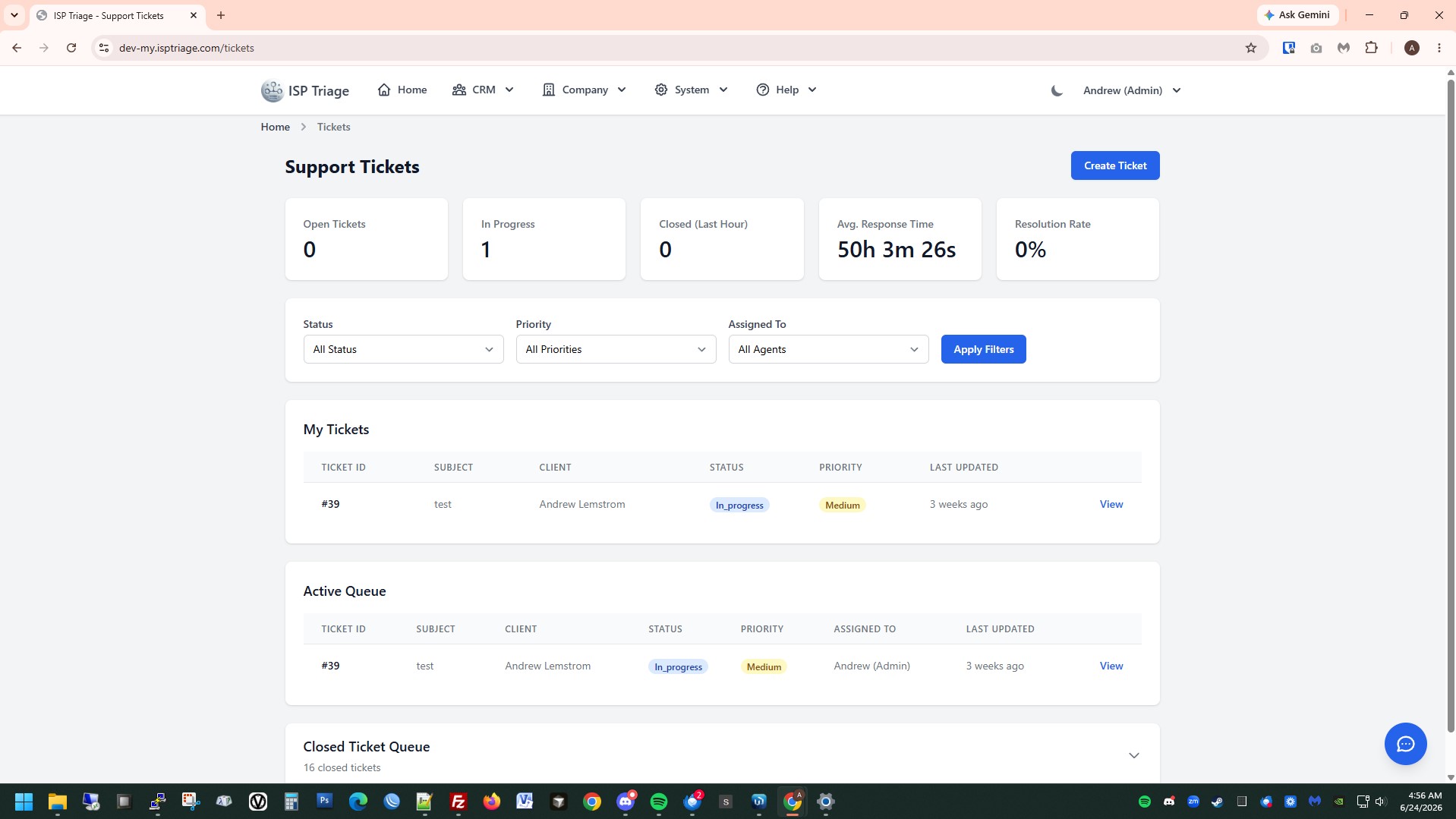
Tickets and truck rolls open against the same customer and network context your billing and RADIUS already know.

  • Ticketing with AI-assisted responses
  • Projects, events/calendar, and truck-roll coordination
  • Outage management and customer notifications

Proactive quality & monitoring

Close the loop: quality problems become tickets before they become cancellations.

  • LibreQoS integration for per-connection Quality of Experience (QoE) scores
  • Automatic tickets when quality drops — fix problems before churn
  • Lightweight monitoring agents for network performance

Hosted voice (FS PBX)

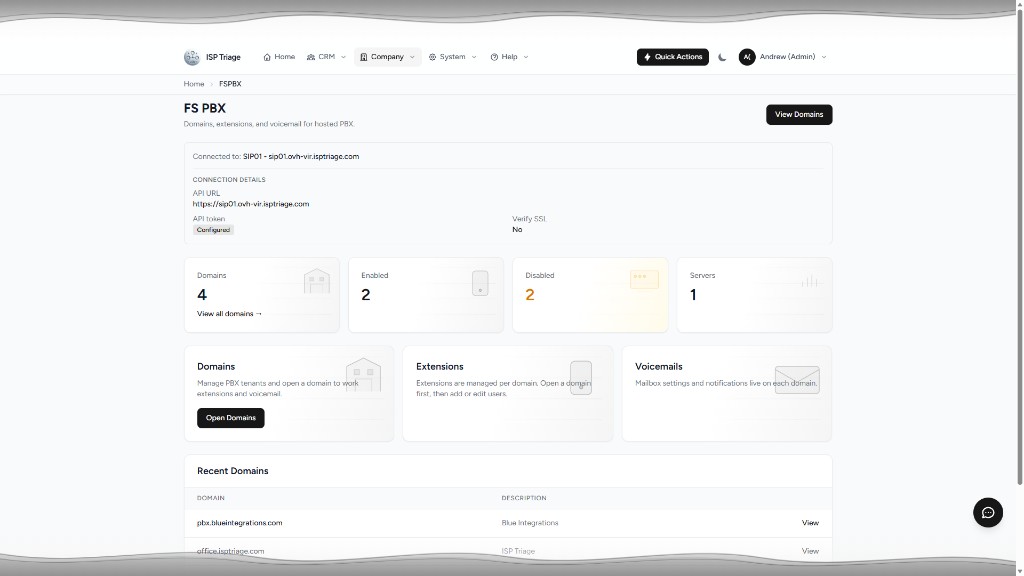
Provision domains, extensions, and voicemail from the same CRM that bills the subscriber — FreeSWITCH without a second admin stack.

  • Connect hosted FreeSWITCH (FS PBX) servers and manage multiple PBX tenants
  • Domains, extensions, and voicemail mailboxes per customer
  • Server status, API credentials, and SSL settings in one place
  • User and extension sync with billing and subscriber records
  • Thirdlane PBX integration is in development for multi-tenant voice operators

Authoritative DNS (PowerDNS)

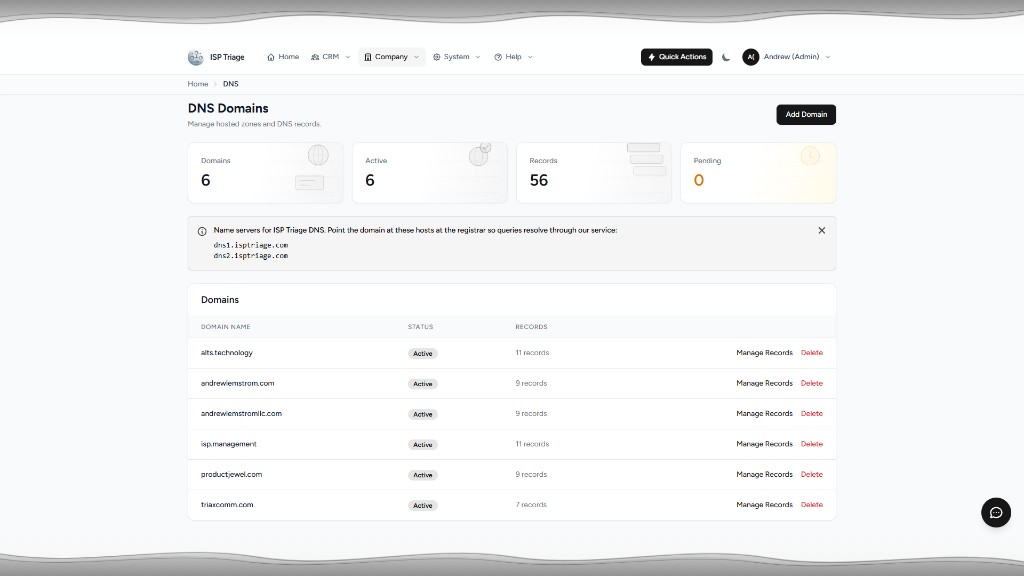
Hosted zones and records live next to the subscriber — point the domain at ISP Triage nameservers and manage DNS without leaving the CRM.

  • Create and manage hosted zones with live record counts and status
  • Add, edit, and delete DNS records from the same tenant that owns the customer
  • Nameserver guidance so domains resolve through ISP Triage DNS
  • Zones stay tied to subscriber and service records as accounts change

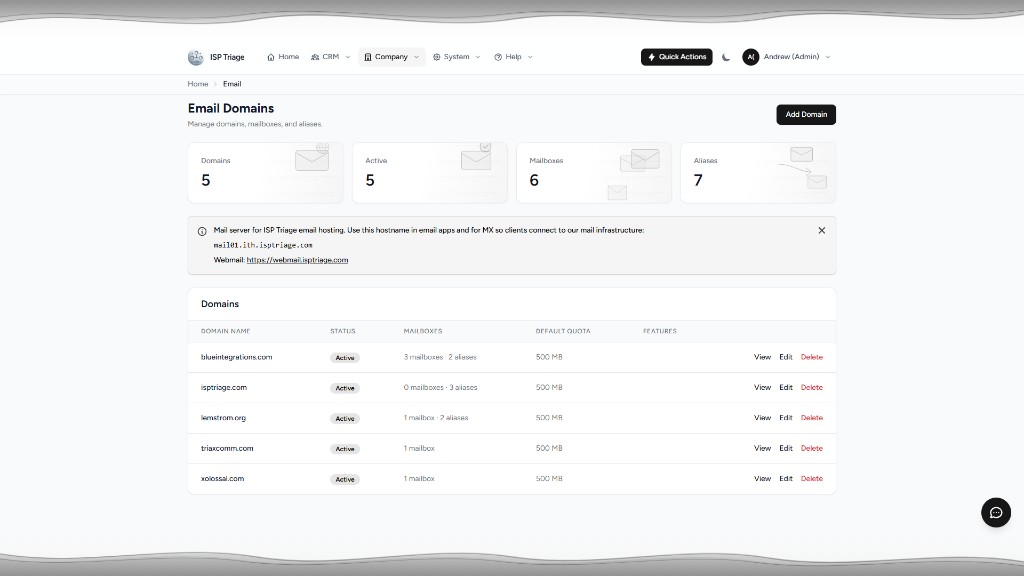
Email hosting (Modoboa)

Domains, mailboxes, and aliases on the subscriber record — webmail and IMAP without a second control panel.

  • Domain, mailbox, alias, and quota management per customer
  • Mail server hostname and webmail for subscriber apps and MX
  • Spam protection, forwarding, and custom-domain support
  • Open-source Modoboa stack with a modern admin view

Talk to the system in plain English (MCP)

MCP is a small connector you add to an assistant you already use — Grok, ChatGPT, or Claude — so it can read ISP Triage the same way you would. You are not learning a new chat product. You are giving the bot you already talk to a live view of tickets, billing, and monitoring.

In this example the MCP is on a Grok bot. Ask for a company overview and it answers in a sentence, not a dashboard: how many tickets are open, who they belong to, what is overdue, and whether hosts are up. Then you stay in the same thread — “show me the high-priority ones” or “what is overdue” — instead of clicking through screens.

  • Works with Grok, ChatGPT, and Anthropic (Claude) through the same MCP
  • Add it to a Grok bot and keep the chat you already have
  • Ask everyday questions: what is going on today, who is overdue, is anything down
  • Follow-ups stay in conversation — no extra login or training course
  • The assistant is another door in; the data stays in ISP Triage

Our webmail client

That inbox is our webmail client. The same assistant layer covers AI summaries, an in-product AI chatbot, and MCP support — so outreach and inbox work stay next to tickets and billing.

  • AI Summaries
  • AI chatbot
  • MCP support

GrokBot as an example

Sending cold emails to potential clients from the same conversation.

Under the hood

Built on engines operators already trust

We orchestrate proven open and commercial infrastructure — not a black-box rewrite — unified with CRM, billing, and network control.

FreeRADIUS

AAA, live sessions, CoA/disconnect, and MikroTik/Cambium vendor attributes.

PowerDNS

Authoritative DNS tied to subscriber and service records.

FS PBX

FreeSWITCH-based telephony provisioning and VoIP service workflows.

Thirdlane

PBX integration in development for multi-tenant voice operators.

Modoboa

Email hosting, mailboxes, and webmail for subscriber-facing services.

LibreQoS

Per-connection QoE scoring and proactive quality alerts.

MCP

Plain-English access from Grok, ChatGPT, and Claude — tickets, billing, and monitoring in the chat you already use.

View integration details

How we compare

One platform vs. piecing tools together

Teams often evaluate Sonar, Splynx, UISP/UCRM, Powercode, and Gaiia — or stitch FreeRADIUS, PowerDNS, FS PBX, and Modoboa themselves. Here is how ISP Triage lines up.

Capability ISP Triage Sonar Splynx UISP / UCRM Powercode Gaiia
CRM & subscriber billing
RADIUS (FreeRADIUS-backed) Partial Partial Partial
MikroTik, UniFi & Cambium control Partial MikroTik 80% · UniFi 30% · Cambium 20% Partial Ubiquiti-focused Partial Partial
GIS & plant mapping Partial Limited Partial Partial
QoE monitoring (LibreQoS) Partial Partial
Ticketing & outage workflows Partial
FS PBX, PowerDNS & Modoboa Partial Partial Limited Partial Partial
MCP for Grok, ChatGPT & Claude
MSP network engineering (same team)

Capability labels reflect typical product scope as of 2026 and vary by plan, deployment, and integrations. Book a demo to walk through your stack.

Services first

Need engineers before software?

Most clients start with network engineering — design, break/fix, migrations — then adopt the CRM when they want one system. The platform is optional; the expertise is not.

Platform demo

See the platform on your stack

Walk through billing, RADIUS, gear, and QoE with an engineer who has run the same gear.

Book a platform demo

Stay Updated

Subscribe for product updates and ISP operations insights.